
Why Self-Blame Is So Common in Homeschooling

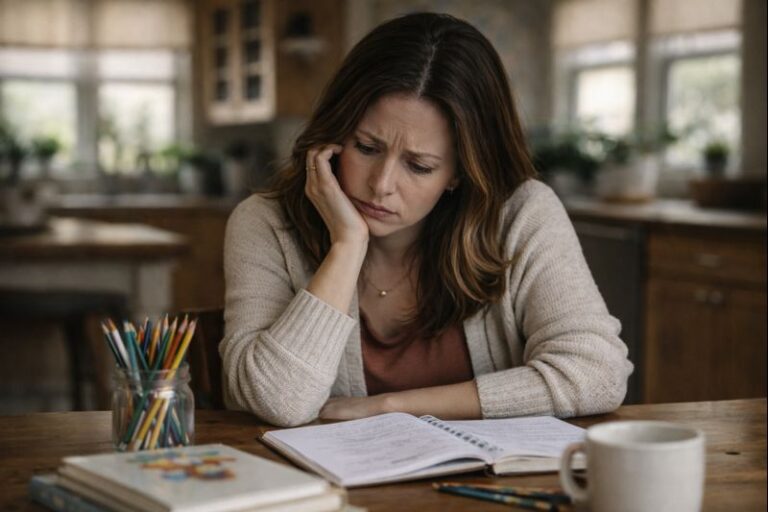
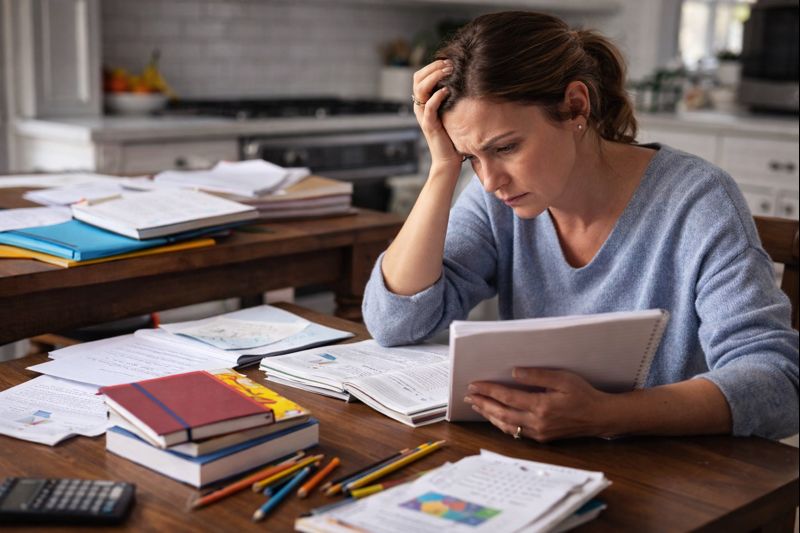
There is a pattern many homeschooling parents fall into so quietly that they don’t even realize it’s happening.
Something goes wrong.
A lesson doesn’t land.
Your child resists.
You feel overwhelmed.
And almost instantly, the mind says:
“This is my fault.”
Not as a dramatic accusation.
Not as a conscious choice.
But as a reflex.
Self-blame becomes the default explanation — so familiar that it feels like truth.
Self-blame doesn’t mean you’re harsh — it means you’re responsible
Many homeschooling parents assume that if they blame themselves often, it must mean they’re too critical or too hard on themselves.
But that’s not the whole picture.
Self-blame in homeschooling rarely comes from cruelty toward yourself.
It comes from responsibility without boundaries.
When you homeschool, you are not just involved — you are accountable.
And when accountability is high and support is low, self-blame fills the gap.
When there is no external system, the mind turns inward
In most educational systems, responsibility is shared.
There are teachers.
Administrators.
Curricula.
Policies.
So when something goes wrong, the mind can distribute the weight.
Homeschooling removes that structure.
There is no external authority to point to.
No institutional buffer.
No one else “in charge.”
So when difficulty arises, the mind asks:
“Who is responsible for this?”
And the only clear answer is: you.
Not because you did something wrong —
but because you are the system.
The brain prefers self-blame over uncertainty
This may sound counterintuitive, but self-blame often feels safer than uncertainty.
Uncertainty sounds like:
- “I don’t know why this is happening.”
- “I don’t know if this is normal.”
- “I don’t know what this means long-term.”
That kind of not-knowing is deeply uncomfortable.
Self-blame offers a quick resolution:
“It’s my fault.”
It gives the mind a story.
A cause.
A sense of control.
Even if that control is painful.
Self-blame is often mistaken for accountability
Many homeschooling parents believe that if they stop blaming themselves, they’ll stop being responsible.
They fear that self-compassion will turn into carelessness.
But self-blame and accountability are not the same thing.
Accountability says:
“This matters to me, and I’m paying attention.”
Self-blame says:
“If anything goes wrong, it means I am wrong.”
One keeps you engaged.
The other keeps you stuck.
Homeschooling activates a deep belief: “If I chose this, I must carry everything”
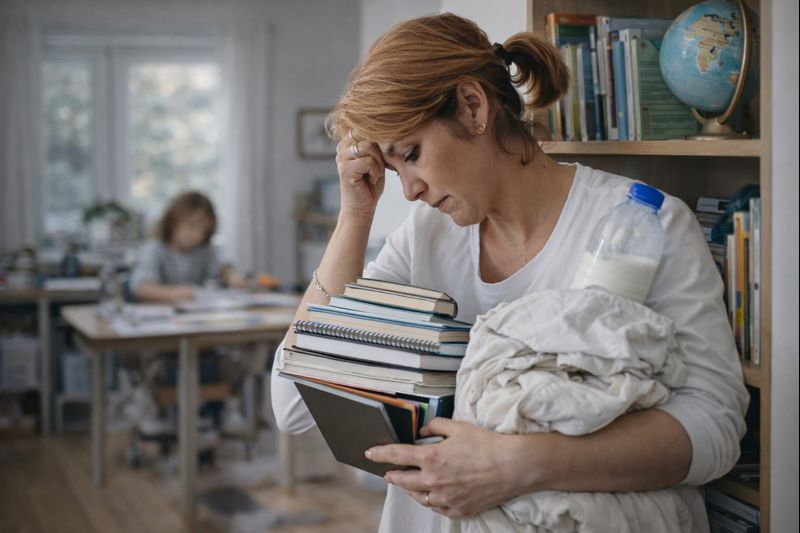
Self-blame is especially common among homeschooling parents because of one powerful belief:
“I chose this.”
Choice feels like ownership.
Ownership feels like total responsibility.
And total responsibility quietly turns into self-punishment.
You may think:
- “I don’t get to complain.”
- “Other people didn’t sign up for this.”
- “If this is hard, that’s on me.”
But choosing something meaningful does not obligate you to suffer silently inside it.
The absence of feedback intensifies self-blame
In many roles, feedback interrupts self-blame.
A boss says, “You’re doing fine.”
A colleague says, “This part is hard for everyone.”
A system offers benchmarks.
Homeschooling parents often get none of that.
So the mind fills the silence with its own commentary.
And internal commentary, without correction, tends to skew negative.
Not because you’re pessimistic —
but because the brain is scanning for danger and responsibility.
Self-blame grows where love and fear intersect
You don’t just want your child to learn.
You want them to be okay.
Emotionally.
Socially.
Psychologically.
That love creates fear:
“What if I mess this up?”
Fear looks for certainty.
And certainty often arrives in the form of blame.
“If I hold myself responsible for everything, maybe I can prevent harm.”
Self-blame becomes a misguided attempt at protection.
Cultural narratives quietly reinforce this pattern
Many homeschooling parents are surrounded by subtle cultural messages:
- “You’re brave to take this on.”
- “That’s a huge responsibility.”
- “I could never do that.”
While often meant as compliments, these messages reinforce a dangerous idea:
“This all rests on you.”
Over time, the pressure to “do it right” turns inward.
And self-blame becomes the price of being seen as responsible.
Self-blame feels productive — until it isn’t
At first, self-blame can feel motivating.
It feels like:
- Taking ownership
- Being honest
- Holding yourself to a standard
But over time, it stops producing clarity and starts producing collapse.
You may notice:
- Constant second-guessing
- Difficulty trusting your instincts
- Emotional exhaustion
- A shrinking sense of confidence
Self-blame doesn’t sharpen judgment.
It dulls it.
This pattern has nothing to do with being a bad parent
It’s important to say this plainly:
Self-blame is not a sign that you are failing.
It is a sign that you:
- Care deeply
- Feel alone with responsibility
- Lack external validation
- Are operating under long-term uncertainty
Anyone in that position would experience the same reflex.
This is not a personal flaw.
It is a predictable psychological response.
When self-blame becomes the background noise of your days
Some parents don’t even notice how constant self-blame has become.
It sounds like:
- “I should have handled that better.”
- “I’m not doing enough.”
- “I’m missing something.”
It becomes the tone of your inner world.
And when that happens, even good moments don’t land.
Because you’re already bracing for the next mistake.
Self-blame keeps you focused on yourself — instead of the situation
One of the quiet costs of self-blame is how it narrows perspective.
Instead of asking:
“What’s happening here?”
You ask:
“What’s wrong with me?”
And when attention turns inward like that, responsiveness disappears.
You’re no longer engaging with your child, the context, or the moment.
You’re managing an internal trial.
You don’t need self-blame to stay caring or committed
This is an important truth many homeschooling parents struggle to believe:
You can be deeply committed without being self-punishing.
Letting go of self-blame does not mean letting go of care.
It means making room for perspective.
Perspective allows adjustment.
Self-blame only allows judgment.
Before you move on
If you notice self-blame showing up again and again, pause before believing it.
Not to argue with it.
Not to replace it with positivity.
Just to recognize it for what it is:
A reflex born from responsibility, love, and isolation —
not a verdict on your worth as a parent.
You don’t need to eliminate self-blame today.
You don’t need to fix your inner dialogue.
You only need to stop mistaking it for truth.
And sometimes, that small shift is enough to soften the weight you’ve been carrying.