You’re Teaching, Parenting, Managing, Regulating — All at Once

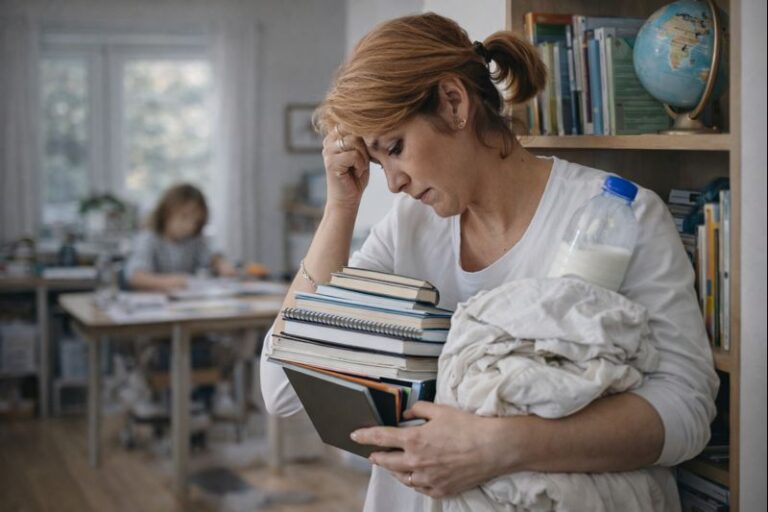
Many homeschooling parents describe their days as exhausting — but struggle to explain why.
They didn’t teach all day.
They didn’t leave the house.
They didn’t complete anything dramatic.
And yet, by the end of the day, they feel spent.
Not just tired — but done.
That exhaustion doesn’t come from one role.
It comes from holding too many roles at the same time — without ever fully stepping out of any of them.
Homeschooling doesn’t add a role — it layers them
When people think about homeschooling, they often imagine one main role:
Teacher.
But homeschooling parents know the truth.
Teaching is only one layer — and often not the heaviest one.
At the same time, you are:
- Parenting
- Managing logistics
- Monitoring emotions
- Regulating conflict
- Anticipating needs
- Holding the household together
And unlike other roles in life, these don’t happen in sequence.
They happen simultaneously.
There is no clean transition between roles
In most work environments, roles are separated by time or space.
You work — then you go home.
You teach — then the bell rings.
You manage — then the task is complete.
Homeschooling collapses those boundaries.
You might be:
- Explaining a concept
- While soothing frustration
- While watching the clock
- While managing your own reaction
- While thinking about what comes next
All in the same moment.
There is no pause between “teacher” and “parent.”
No switch to flip.
And that constant overlap is mentally and emotionally draining.
Teaching alone is not what exhausts you
Teaching is effortful — but it’s not the whole story.
What exhausts homeschooling parents is teaching while regulating emotions.
You’re not just conveying information.
You’re watching:
- Body language
- Tone
- Attention
- Emotional shifts
And adjusting in real time.
You’re deciding:
- When to push
- When to stop
- When to comfort
- When to redirect
That kind of responsive presence is demanding.
It requires you to be alert, attuned, and flexible — continuously.
Parenting doesn’t pause when teaching begins
In institutional settings, teachers are not responsible for the child’s entire emotional world.
Parents are.
In homeschooling, that responsibility never turns off.
You’re not just addressing learning.
You’re addressing:
- Frustration
- Self-esteem
- Resistance
- Fatigue
- Emotional safety
So when a lesson struggles, you’re not just thinking:
“How do I teach this better?”
You’re also thinking:
“How is this affecting them?”
“Am I damaging our relationship?”
“What will they remember about this?”
That emotional weight sits on top of the academic task.
Management is happening quietly in the background
While teaching and parenting are visible,
managing is often invisible.
You are tracking:
- Time
- Energy
- Transitions
- Materials
- Appointments
- Household needs
You are constantly answering:
- “What’s next?”
- “What needs attention?”
- “What can wait?”
Even when nothing urgent is happening,
management lives in your mind.
And mental management — especially when it never ends — is exhausting.
Emotional regulation is a full-time role on its own
One of the least acknowledged roles homeschooling parents play is emotional regulator.
You are:
- Absorbing your child’s stress
- Calming escalations
- Monitoring your own reactions
- Trying not to pass your overwhelm on
You are regulating two nervous systems at once.
And emotional regulation is not passive.
It’s active, effortful, and draining.
Especially when you don’t get to step away from it.
Why this combination leads to rapid depletion
Each of these roles — teaching, parenting, managing, regulating — is demanding on its own.
But the real cost comes from doing them all at once.
There is:
- No role clarity
- No handoff
- No downtime between demands
Your system never gets to fully rest in one role.
It’s always preparing for the next interruption.
This kind of constant switching is one of the fastest paths to exhaustion — even if the day looks “easy” from the outside.
Overload doesn’t announce itself — it erodes
Most homeschooling parents don’t wake up one day feeling burned out.
Instead, they notice:
- Shorter patience
- Lower tolerance
- Less joy
- More self-doubt
And because they’re still functioning, they assume:
“I should be able to handle this.”
But erosion is quieter than collapse.
And much harder to recognize.
You are not failing — you are multitasking at a human level
Modern culture often celebrates multitasking.
But human nervous systems are not designed to perform multiple high-stakes roles simultaneously — for long periods — without relief.
Homeschooling parents are not failing because they feel overwhelmed.
They are overwhelmed because they are doing what would challenge any human system.
The problem is not effort.
It’s load.
Why this feels harder at home than it would elsewhere
At home, there are no formal role markers.
No titles.
No uniforms.
No physical separation.
You are always “on.”
Your child doesn’t see you as:
- Teacher from 9–11
- Parent after lunch
They see you as you — all the time.
So boundaries blur.
Expectations overlap.
And recovery becomes harder.
This is why even quiet days can feel heavy
Some days don’t include conflict.
Or chaos.
Or crisis.
And yet, you still feel exhausted.
That’s because the work isn’t in what happened —
it’s in what you held.
You held:
- Attention
- Readiness
- Emotional presence
- Responsibility
And holding is work — even when nothing explodes.
You were never meant to hold all of this alone
Historically, education and caregiving were shared.
Multiple adults.
Multiple roles.
Distributed responsibility.
Modern homeschooling often concentrates all of that into one person.
That concentration is not a personal flaw.
It’s a structural reality.
And it explains why so many capable, caring parents feel depleted.
You don’t need to do better — you need to be less alone in the roles
This matters:
Your exhaustion is not a sign that you need to improve.
It’s a sign that the load is too concentrated.
More skill will not fix structural overload.
More effort will not replace shared support.
You don’t need to become stronger.
You need the roles to be lighter — or fewer — or shared.
Before you move on
If you’ve been feeling worn down without knowing why, pause here.
You are not “bad at homeschooling.”
You are not lacking discipline.
You are not emotionally weak.
You are teaching.
You are parenting.
You are managing.
You are regulating.
All at once.
And that is a lot for one person to carry — day after day — without relief.
Recognizing that truth
doesn’t solve everything.
But it stops the self-blame.
And sometimes,
that’s where real healing begins.