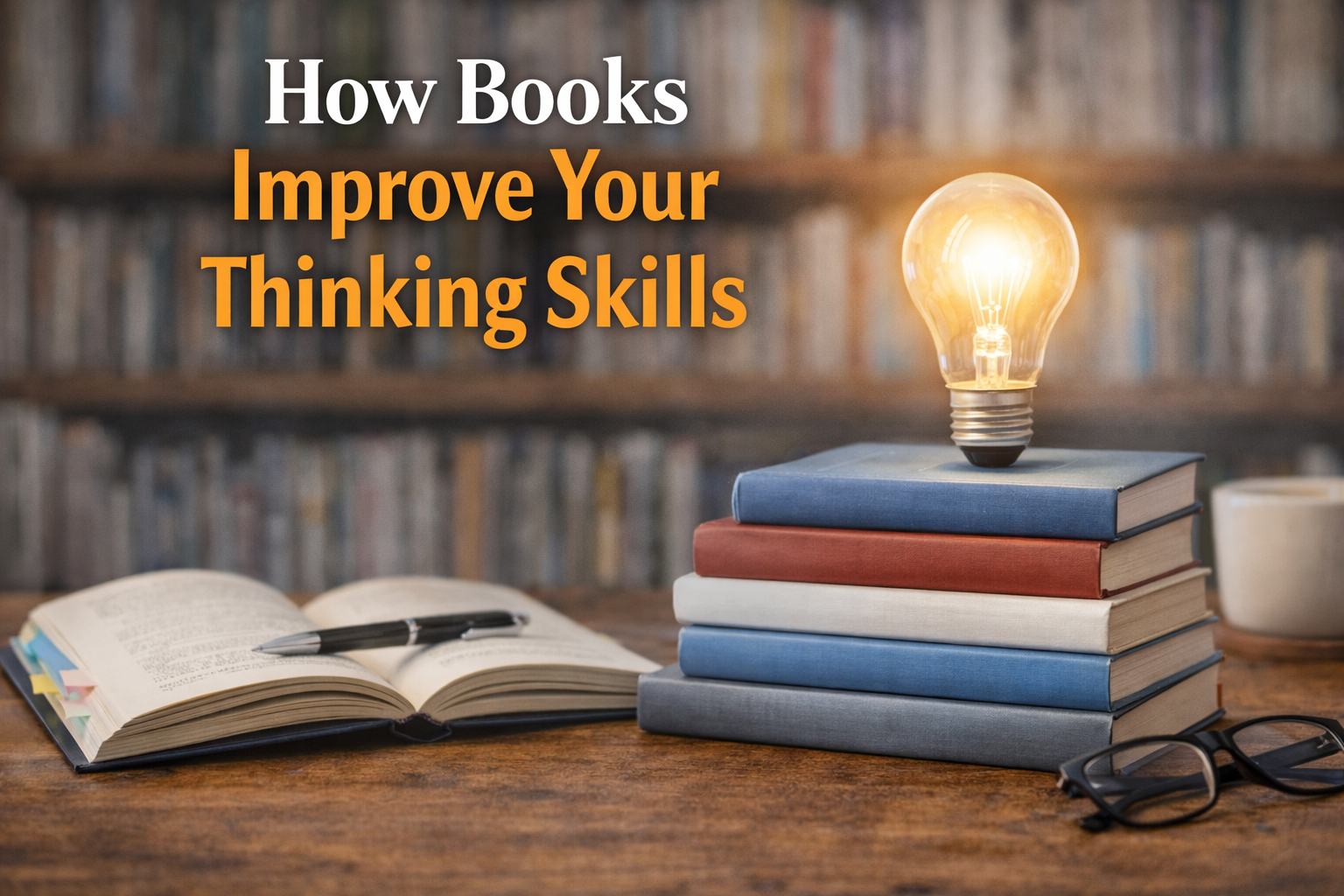
How Books Improve Your Thinking Skills
I still remember the first time I realized that reading was doing something to my mind that nothing else could. It wasn’t loud or dramatic. There was no sudden spark, no cinematic moment where everything made sense at once. It was quieter than that—almost invisible. But it was real.
I was sitting alone, flipping through the pages of a novel I had picked up without much expectation. At first, I was just following the story, letting the characters move through their world while I stayed comfortably outside of it. But somewhere along the way, something shifted. I began asking questions—not just about what would happen next, but why things were happening at all. Why did a character make a certain decision? Why did their emotions feel so familiar, even though their life was nothing like mine?
That was the moment I realized: books don’t just tell stories. They quietly train your mind to think deeper.
Reading Teaches You to Slow Down and Think
In a world where everything moves fast—short videos, quick messages, instant answers—books demand something different from you. They ask you to slow down.
When you read, you can’t rush the process without losing meaning. Every sentence builds on the last. Every paragraph carries weight. And in that slower pace, your brain begins to stretch in ways it normally wouldn’t.
You start to notice details. You connect ideas. You pause, reflect, and sometimes even reread a passage just to understand it better. That act alone—slowing down and thinking carefully—is a skill that carries over into everything else in life.
Over time, I noticed I wasn’t just reading more carefully. I was thinking more carefully too. I questioned things more. I paid attention to details I would have ignored before. Books had quietly taught me patience—not just with reading, but with thinking itself.
Books Expand the Way You See the World
One of the most powerful things about reading is that it allows you to live lives you’ve never lived.
You can step into the mind of someone from a different country, a different background, or even a completely different time in history. You see their struggles, their beliefs, their way of understanding the world.
And slowly, almost without realizing it, your perspective begins to widen.
I remember reading a story about a character whose choices I strongly disagreed with at first. I judged them quickly, confident in my own viewpoint. But as the story unfolded, I began to understand their reasons. Not necessarily agree—but understand.
That distinction matters.
Books don’t always change your opinions. But they teach you to see beyond your own perspective. They show you that people are complicated, that situations are rarely simple, and that understanding someone doesn’t mean you have to agree with them.
This kind of thinking—open, flexible, and curious—is one of the most valuable skills you can develop.
Reading Strengthens Your Ability to Focus
At first, it’s hard.
You sit down with a book, and your mind drifts after a few pages. You check your phone. You reread sentences because you weren’t really paying attention the first time.
But if you keep going, something changes.
Your focus improves.
Books train your brain to stay with one idea for an extended period of time. They build your ability to concentrate, to follow complex thoughts, and to hold multiple ideas in your mind at once.
This doesn’t happen overnight. It’s gradual. But it’s powerful.
And the best part? This improved focus doesn’t stay limited to reading. It shows up in your studies, your conversations, and even the way you approach problems.
You become more present. More attentive. More engaged.
Books Improve Your Critical Thinking
Not everything in a book is meant to be accepted blindly.
Good readers don’t just absorb information—they question it.
As you read more, you start to notice patterns. You recognize arguments. You detect biases. You learn to separate fact from opinion, and you become more aware of how ideas are presented.
Sometimes, you might even disagree with the author. And that’s a good thing.
Because in that disagreement, your mind is working. You’re analyzing, comparing, evaluating. You’re not just reading—you’re thinking.
I found myself doing this more often over time. I would pause mid-chapter and think, Do I really believe this? or Is there another way to see this situation?
Those moments matter. They turn reading into an active process rather than a passive one.
And that’s where real growth happens.
Reading Helps You Understand Yourself
This was the part I didn’t expect.
Somewhere between the pages, I started finding pieces of myself.
A character’s fear that mirrored my own. A decision that felt painfully familiar. A thought I had never put into words until I saw it written by someone else.
Books have a way of doing that—of holding up a mirror when you least expect it.
They help you make sense of your own emotions. They give language to things you couldn’t explain before. And sometimes, they even help you see parts of yourself you didn’t know were there.
It’s not always comfortable. But it’s always valuable.
Because understanding yourself is one of the most important forms of thinking there is.
Stories Teach You to Think in Possibilities
When you read fiction, you’re constantly imagining.
What will happen next? What could have happened differently? What would I do in that situation?
These questions may seem simple, but they train your brain to think in possibilities.
Instead of seeing situations as fixed and unchangeable, you begin to see them as flexible. You realize there are always multiple paths, multiple outcomes, multiple ways to respond.
This kind of thinking is incredibly useful in real life.
It helps you problem-solve. It helps you adapt. It helps you stay open-minded when things don’t go as planned.
And it all starts with something as simple as turning a page and wondering what comes next.
The Quiet Transformation
The most interesting thing about reading is that its impact is rarely immediate.
You don’t finish a book and suddenly feel like a completely different person. There’s no instant transformation.
Instead, the change happens slowly, over time.
A new way of thinking here. A deeper understanding there. A moment of clarity you can’t quite trace back to a single source.
And then one day, you realize something has shifted.
You approach problems differently. You listen more carefully. You think before you speak. You see connections that you wouldn’t have noticed before.
Books don’t force this change. They build it, piece by piece.
Why It Matters More Than Ever
In today’s world, information is everywhere. You can find answers instantly. You can learn almost anything with a few clicks.
But thinking—real, deep, meaningful thinking—is becoming rare.
That’s why books matter more than ever.
They don’t just give you information. They teach you how to process it. How to question it. How to connect it to everything else you know.
They train your mind in a way that quick content never can.
And while it might feel slower, less exciting, or even challenging at times, the rewards are worth it.
A Personal Reflection
Looking back, I can’t point to a single book that changed everything for me.
Instead, it was all of them.
Every story, every idea, every page contributed something. Some left a strong impression. Others seemed forgettable at the time, but somehow stayed with me in subtle ways.
Together, they shaped how I think.
They made me more curious. More patient. More open to different perspectives. More willing to question and to reflect.
And maybe that’s the most important lesson of all:
Reading doesn’t just make you smarter.
It makes you think better.
Final Thoughts
If you’ve ever felt like reading is slow or difficult, you’re not alone. It takes effort. It takes time. And sometimes, it even feels frustrating.
But that’s part of the process.
Because every time you sit down with a book, you’re not just reading words—you’re training your mind.
You’re learning how to focus, how to question, how to understand, and how to think.
And over time, those skills become a part of you.
So the next time you open a book, don’t rush it.
Let yourself get lost in the pages. Let your mind wander, question, and explore.
Because somewhere in that quiet process, your thinking is changing—one page at a time.