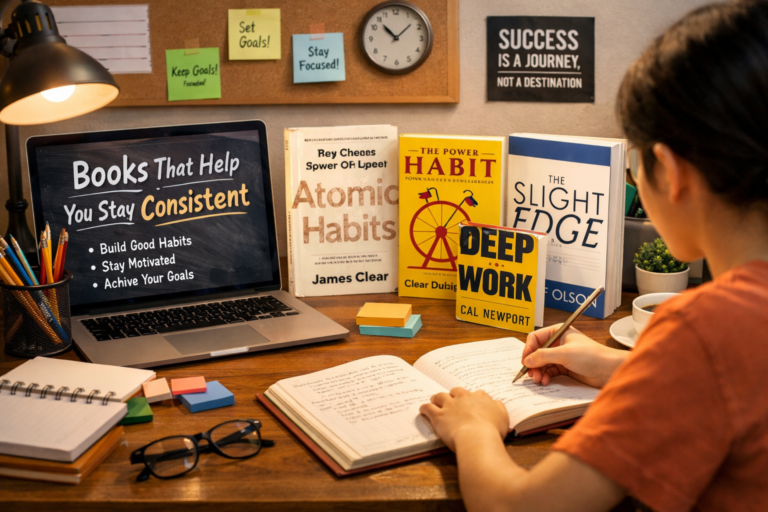

How Books Help You Escape Mediocrity

How Books Help You Escape Mediocrity
For a long time, I didn’t think of myself as “stuck.”
I wasn’t failing. I wasn’t completely lost. I was doing what I was supposed to do—following routines, meeting expectations, moving forward in small, predictable steps.
From the outside, everything looked fine.
But inside, there was a quiet feeling I couldn’t ignore.
It wasn’t frustration. It wasn’t even dissatisfaction.
It was something softer—but more persistent.
A sense that I was capable of more… but wasn’t quite reaching it.
At the time, I didn’t have a word for it.
Now, I think I do.
Mediocrity.
The Comfortable Trap
The strange thing about mediocrity is that it doesn’t feel like a trap at first.
It feels comfortable.
You’re not struggling enough to be forced to change. But you’re not growing enough to feel fulfilled either.
You stay in the middle.
Safe. Predictable. Unchallenged.
And that’s what makes it dangerous.
Because nothing pushes you out of it.
No urgency. No crisis. Just a slow, quiet acceptance of “good enough.”
For a while, I didn’t question it.
Until something small shifted.
The First Disruption
It started with a book.
Not a dramatic one. Not something that claimed to change everything.
Just a simple idea, written in a way that made it impossible to ignore:
You are shaped by what you repeatedly expose your mind to.
I didn’t react immediately.
But the thought stayed.
Because when I looked at my daily life, I realized something uncomfortable.
Most of what I consumed required very little from me.
Quick content. Easy entertainment. Things that filled time—but didn’t challenge me.
And slowly, without realizing it, my thinking had adapted to that level.
Shallow. Reactive. Comfortable.
That realization didn’t feel good.
But it was necessary.
Books Demand More From You
Unlike most forms of content, books don’t adjust to your attention span.
They ask you to meet them where they are.
They require focus. Patience. Effort.
At first, that feels inconvenient.
But over time, it becomes something else.
It becomes growth.
Because when you engage with ideas that are deeper than your current thinking, your mind has to stretch.
You have to slow down. Reflect. Question.
And in that process, something begins to change.
Exposure Changes Everything
One of the most powerful ways books help you escape mediocrity is through exposure.
Not just to information—but to new ways of thinking.
Different perspectives. Higher standards. Bigger possibilities.
Before reading consistently, my view of what was “normal” was limited to what I saw around me.
But books expanded that.
They introduced me to people who thought differently. Acted differently. Expected more from themselves.
And once you see that, it’s hard to go back.
Because your definition of what’s possible begins to shift.
Raising Your Internal Standards
Mediocrity often comes from low standards—not consciously, but quietly.
You accept less effort. Less focus. Less intention.
Not because you want to—but because it feels normal.
Books challenge that.
They show you what discipline looks like. What deep thinking looks like. What intentional living looks like.
And over time, your internal standards begin to rise.
You start noticing when you’re settling.
Not with guilt—but with awareness.
And that awareness creates choice.
Thinking Beyond the Surface
One of the clearest changes I noticed was in how I think.
Before, I often stayed on the surface.
Quick conclusions. Simple answers. Immediate reactions.
But reading made that harder to do.
Because books don’t always give you clear answers.
They present ideas. Arguments. Nuance.
And you have to sit with them.
Think about them.
Sometimes even struggle with them.
That process builds depth.
And depth is the opposite of mediocrity.
The Shift From Passive to Active
Mediocrity thrives in passivity.
When you consume without thinking. When you follow without questioning. When you move without intention.
Reading interrupts that.
It turns you into an active participant.
You’re not just receiving information—you’re engaging with it.
Agreeing. Disagreeing. Interpreting. Reflecting.
And that shift—from passive to active—changes how you approach everything else.
You Start Asking Better Questions
One of the most subtle but powerful changes is in the questions you ask.
Before, my questions were often simple:
What should I do?
What’s the easiest option?
But after reading more, the questions changed:
Why does this matter?
Is there a better way?
What am I not seeing?
Better questions lead to better thinking.
And better thinking leads to better decisions.
Discomfort Becomes Valuable
At first, I avoided difficult books.
Anything that felt challenging, slow, or hard to understand—I would put it down.
But over time, that changed.
I started to see discomfort differently.
Not as something to avoid—but as something to pay attention to.
Because often, the ideas that challenge you the most are the ones that help you grow.
And growth rarely feels comfortable.
Books taught me to stay with that discomfort.
To think through it, instead of stepping away from it.
The Long-Term Effect
Escaping mediocrity doesn’t happen overnight.
There’s no single book that suddenly transforms everything.
But there is a pattern.
You read. You think. You change—slightly.
Then you read again. Think again. Change again.
And over time, those small changes accumulate.
Your standards rise. Your thinking deepens. Your actions become more intentional.
And one day, you realize you’re no longer where you used to be.
A Personal Reflection
Looking back, I don’t think books made me extraordinary.
But they made me more aware.
More intentional. More thoughtful.
They helped me see where I was settling—and where I could do better.
Not in a harsh way.
But in a quiet, steady way that kept pushing me forward.
And that’s what escaping mediocrity really feels like.
Not a dramatic leap—but a continuous movement.
Final Thoughts
Mediocrity isn’t about being average.
It’s about staying where you are, even when you’re capable of more.
And books help you move beyond that—not by forcing you, but by changing how you think.
They expose you to new ideas. Challenge your assumptions. Raise your standards.
And most importantly, they remind you that there is always more to learn, more to understand, more to become.
So if you feel that quiet sense—that you’re capable of more but not quite reaching it—
Start reading.
Not for instant results.
But for gradual transformation.
Because the way you think shapes the way you live.
And books have a way of changing both—one page at a time.