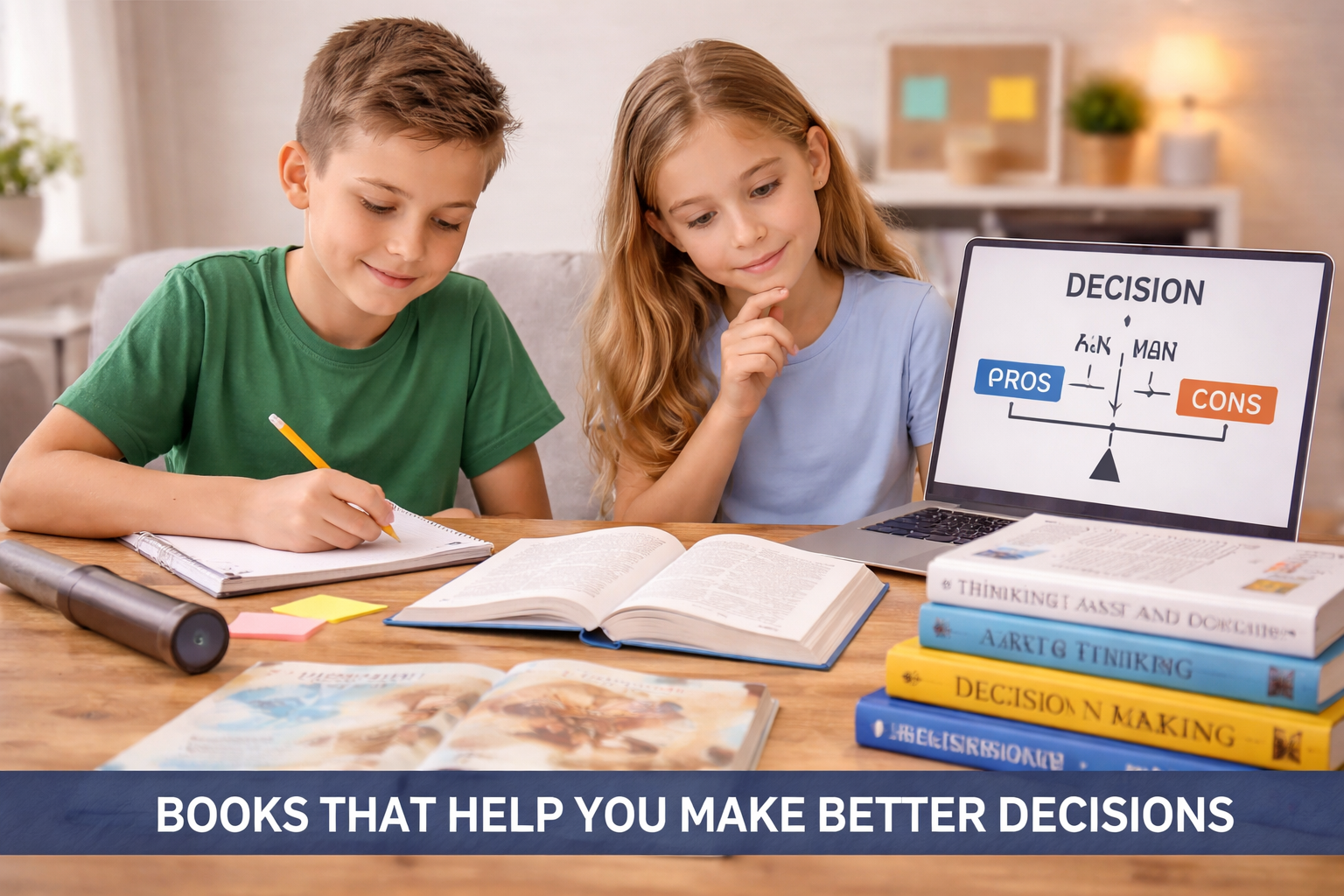
Books That Help You Make Better Decisions
Books That Help You Make Better Decisions
I used to think decisions were about intelligence.
If you were smart enough, you would make the right choice. If you thought long enough, analyzed deeply enough, you would eventually arrive at the best answer.
But in reality, it never felt that clean.
Some of my decisions were rushed. Others were delayed for too long. Sometimes I overthought simple things, and other times I acted too quickly on things that mattered more.
And often, I didn’t understand why I chose the way I did.
That’s what made it frustrating.
Because it didn’t feel like a lack of effort.
It felt like a lack of clarity.
The First Realization: We Don’t Decide as Rationally as We Think
The first shift came from a book that didn’t tell me how to make better decisions.
It showed me how flawed my thinking already was.
That was uncomfortable.
But also necessary.
Books like Thinking, Fast and Slow introduced a simple but powerful idea:
Not all thinking is the same.
Some decisions are fast, automatic, emotional.
Others are slow, deliberate, analytical.
And most of the time, we rely more on the first than we realize.
That explained a lot.
Why I made quick judgments. Why I felt certain about things I hadn’t really examined. Why I sometimes changed my mind after thinking more deeply.
It wasn’t random.
It was how the mind works.
Awareness Changes Everything
Once I understood that, I started noticing it in real time.
Moments where I reacted instantly—before thinking.
Moments where I felt confident without fully understanding why.
And just being aware of that made a difference.
Because awareness creates a pause.
And that pause gives you a choice.
Not always a perfect choice—but a better one.
The Trap of Overthinking
But there was another side to it.
Sometimes, I didn’t make decisions too quickly.
I made them too slowly.
I would analyze every option. Consider every outcome. Try to predict every possible consequence.
And in doing so, I got stuck.
Books that explore decision-making often talk about this balance.
Between thinking enough—and thinking too much.
Because more thinking doesn’t always lead to better decisions.
Sometimes, it just creates more doubt.
Learning to Define What Matters
One of the most helpful lessons I came across was this:
Not all decisions are equally important.
But I often treated them that way.
Small choices felt heavy. Big decisions felt overwhelming.
Books helped me step back and ask:
What actually matters here?
What are the key factors?
What am I really deciding between?
That clarity made decisions feel simpler.
Not easy—but clearer.
The Role of Values
At some point, I realized that many decisions become difficult because you don’t know what you value.
Or you haven’t defined it clearly.
Books that focus on decision-making often bring you back to this idea.
Your values act as a filter.
They help you eliminate options that don’t align with what matters to you.
And once you have that filter, decisions become less confusing.
Because you’re not trying to consider everything.
You’re focusing on what’s relevant.
Accepting Uncertainty
This was one of the hardest lessons.
No decision comes with complete certainty.
There’s always something you don’t know.
Some outcome you can’t predict.
And for a long time, that made me hesitate.
I wanted to be sure before I acted.
But books taught me something different:
You don’t need certainty to make a good decision.
You need enough information—and the willingness to accept the unknown.
That shift changed how I approached choices.
Instead of waiting for perfect clarity, I started acting with reasonable confidence.
Learning From Mistakes
Another important idea:
Good decision-makers are not those who never make mistakes.
They’re the ones who learn from them.
Before, I avoided mistakes.
Or I judged myself harshly when I made them.
But reading changed that perspective.
Mistakes became feedback.
Information about what worked—and what didn’t.
And once I saw it that way, I became less afraid of deciding.
Because even if I was wrong, I would learn something.
Thinking in Probabilities
Some books introduced a concept that felt new at first:
Thinking in probabilities.
Not asking, “Is this the right decision?”
But asking, “What is the likely outcome?”
That shift is subtle—but powerful.
Because it moves you away from certainty and toward likelihood.
And in real life, most decisions are about probabilities, not guarantees.
Understanding that made me more realistic.
And more flexible.
The Importance of Time
One thing I learned is that time changes decisions.
Some decisions need to be made quickly.
Others benefit from waiting.
Knowing the difference matters.
Books often emphasize this:
Not just how you decide—but when you decide.
Because timing affects clarity.
External vs Internal Influence
Another realization:
Not all decisions come from within.
We’re influenced—by opinions, expectations, social pressure.
Sometimes without noticing.
Books helped me become more aware of that.
To ask:
Is this what I want? Or what I think I should want?
That question alone can change a decision.
Simplicity Over Complexity
At some point, I started to simplify my approach.
Instead of trying to find the perfect answer, I looked for a reasonable one.
Something that made sense based on what I knew.
Something I could commit to.
And that made decisions easier.
Because perfection was no longer the goal.
Progress was.
A Personal Reflection
Looking back, I didn’t become better at making decisions overnight.
It happened gradually.
Through reading. Through reflection. Through experience.
Each book added something.
A new perspective. A better question. A clearer way of thinking.
And over time, those pieces came together.
Not perfectly—but enough to make a difference.
Final Thoughts
If you want to make better decisions, books can help—but not by giving you fixed answers.
They help by improving how you think.
They show you patterns. Biases. Frameworks.
They make you more aware—of yourself, your thinking, your choices.
And that awareness is what leads to better decisions.
Not perfect ones.
But better ones.
So read.
Not to find the “right” answer—
but to understand how to think more clearly.
Because in the end, the quality of your decisions depends on the quality of your thinking.
And books have a quiet way of improving both.