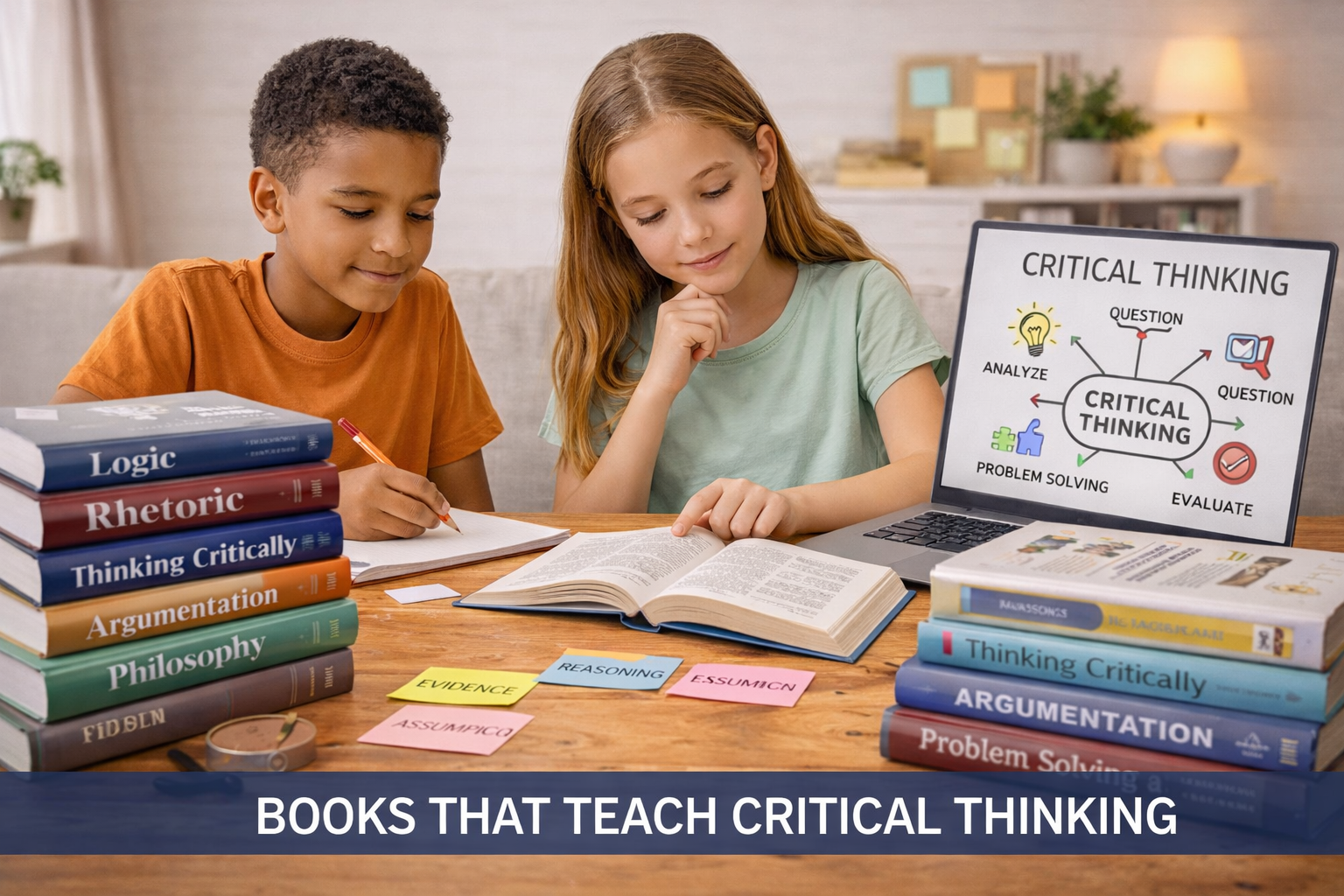
Books That Teach Critical Thinking
Books That Teach Critical Thinking
For a long time, I believed that thinking was automatic.
You see something, you understand it. You hear an argument, you decide whether you agree or disagree. It all felt immediate—almost effortless.
I didn’t question it.
Why would I?
Thinking felt like something I had always been doing.
But over time, I started noticing something uncomfortable.
I wasn’t always thinking—I was often just reacting.
The Moment I Noticed the Difference
It happened during a simple conversation.
Someone shared an opinion, and I immediately agreed. Not because I had thought about it deeply—but because it sounded right.
Later, when I reflected on it, I realized I hadn’t really examined the idea.
I had accepted it.
That moment stayed with me.
Because it made me wonder:
How many of my thoughts are actually mine?
And that question led me to books—not for answers, but for clarity.
Thinking vs Reacting
One of the first things I learned is that there’s a difference between thinking and reacting.
Reacting is fast.
It’s based on habit, emotion, or familiarity.
Thinking is slower.
It requires effort. Attention. Willingness to question.
Books that focus on critical thinking don’t just give you information.
They slow you down.
They force you to stay with an idea long enough to examine it.
And in that process, you start to notice your own patterns.
Questioning What Seems Obvious
Before reading more deeply, I rarely questioned things that seemed obvious.
If something made sense on the surface, I accepted it.
But critical thinking challenges that.
It asks you to look closer.
To ask:
- Is this really true?
- What evidence supports this?
- Is there another way to see it?
At first, this felt uncomfortable.
Because it introduced uncertainty.
But over time, it became a habit.
And that habit changed how I approached everything—from conversations to decisions.
The Role of Assumptions
One of the most eye-opening ideas I encountered was this:
We all operate on assumptions.
Unspoken beliefs that shape how we interpret the world.
The problem is, we’re often not aware of them.
Books that teach critical thinking help bring those assumptions to the surface.
They make you ask:
Why do I believe this?
Where did this idea come from?
And sometimes, the answers are surprising.
Learning to Separate Fact From Opinion
This might sound basic—but it’s harder than it seems.
Especially in a world full of information.
Opinions are often presented as facts. Emotions are mixed with arguments.
And without careful thinking, it’s easy to accept something without questioning it.
Books helped me slow down.
To look at information more carefully.
To ask:
Is this a fact—or an interpretation?
That simple distinction makes a big difference.
Understanding Bias
Another important lesson:
Thinking is not neutral.
We all have biases.
Personal experiences, preferences, beliefs—they all influence how we think.
At first, I thought bias was something other people had.
But reading showed me otherwise.
It helped me recognize my own biases.
Not to eliminate them completely—that’s not realistic—but to be aware of them.
And that awareness made my thinking more balanced.
The Power of Asking Better Questions
Critical thinking isn’t about having all the answers.
It’s about asking better questions.
Before, my questions were often simple:
Is this right or wrong?
But books introduced more nuanced questions:
- What is the evidence?
- What are the alternatives?
- What am I missing?
These questions don’t always lead to clear answers.
But they lead to deeper understanding.
Sitting With Uncertainty
One of the hardest parts of critical thinking is accepting uncertainty.
Not everything has a clear answer.
Not every problem can be solved quickly.
And that can feel uncomfortable.
But books helped me become more comfortable with that discomfort.
To sit with questions. To explore ideas without rushing to a conclusion.
And in doing so, I started to see thinking differently.
Not as a way to find quick answers—but as a process.
The Difference It Makes
Over time, I noticed changes.
Small at first.
I became less reactive. More thoughtful.
I paused before agreeing or disagreeing.
I listened more carefully. Asked more questions.
And those changes affected everything.
Conversations became more meaningful. Decisions became more intentional.
Even the way I understood information became clearer.
Critical Thinking Is a Skill
One of the most important realizations:
Critical thinking is not something you’re born with.
It’s a skill.
And like any skill, it improves with practice.
Books provide that practice.
They challenge your ideas. Present new perspectives. Encourage reflection.
And over time, that practice builds something.
Not perfect thinking—but better thinking.
When It Feels Difficult
There were times when reading felt challenging.
Ideas were complex. Arguments were layered.
It would have been easier to move on.
But staying with those ideas—working through them—was part of the process.
Because difficulty is often where growth happens.
And critical thinking requires effort.
A Personal Reflection
Looking back, I didn’t suddenly become a critical thinker.
It happened gradually.
Through reading. Through questioning. Through reflecting.
Each book added something.
A new perspective. A better question. A deeper understanding.
And over time, those pieces came together.
Not perfectly—but meaningfully.
Final Thoughts
If you want to develop critical thinking, books can help—but only if you engage with them.
Don’t just read passively.
Question what you read. Reflect on it. Connect it to your own experiences.
Because critical thinking isn’t about finding the “right” answer.
It’s about understanding how to think clearly, carefully, and independently.
And in a world full of information, that skill matters more than ever.
So take your time.
Read slowly. Think deeply.
And let the process shape the way you see things—
one idea at a time.