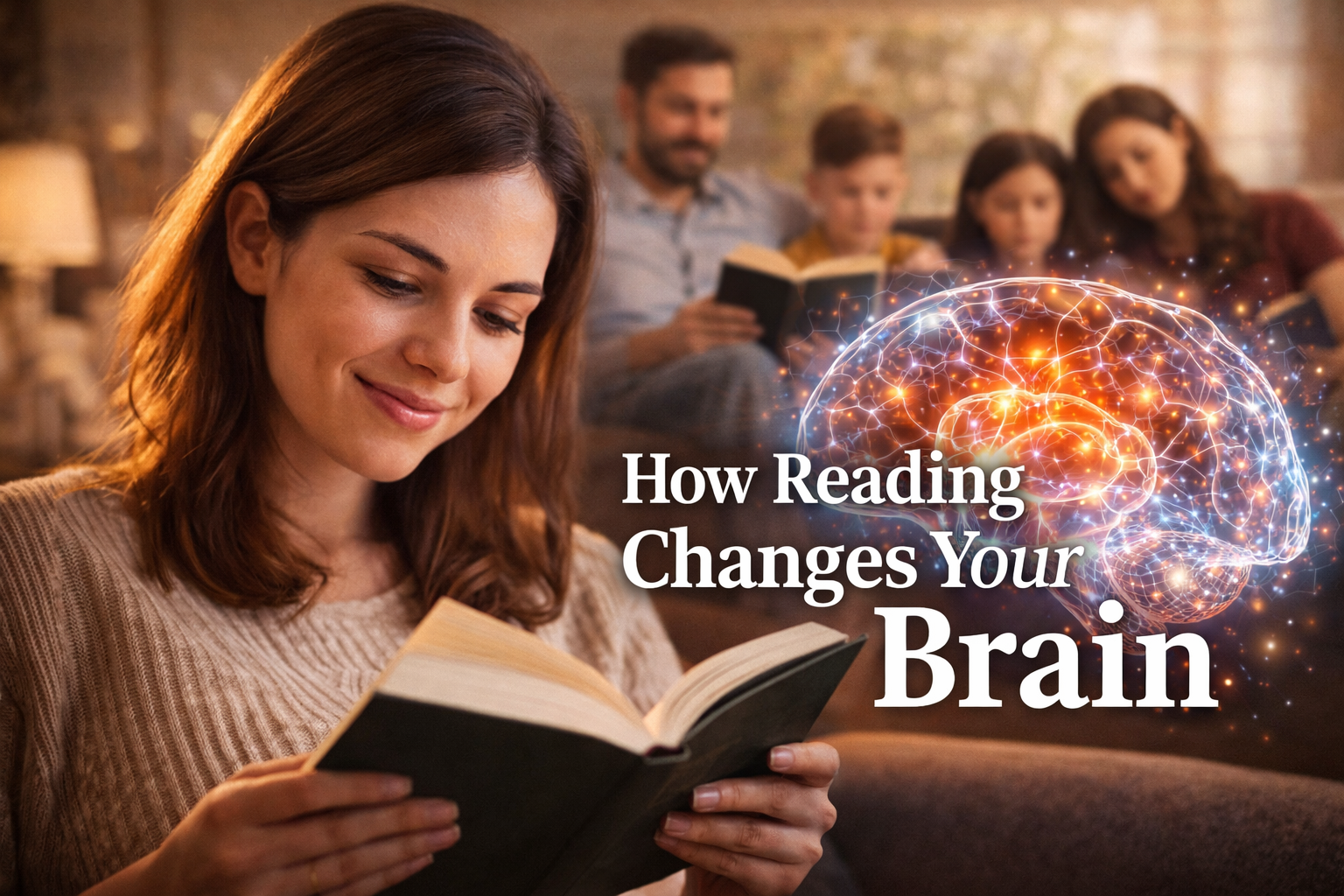
How Reading Changes Your Brain
How Reading Changes Your Brain
I never actually felt my brain changing.
There was no moment where I closed a book and suddenly thought, something is different now. No instant clarity. No dramatic shift.
If anything, it felt like nothing was happening at all.
Just words. Pages. Quiet time spent alone.
But the strange thing about reading is this: the change doesn’t announce itself. It builds slowly, quietly, in the background—until one day, you realize you’re not thinking the same way you used to.
The First Subtle Shift
At some point, I noticed I was pausing more.
Not just while reading—but in everyday life.
Someone would say something, and instead of reacting immediately, I would think about it. Turn it over in my mind. Consider different angles.
That didn’t used to happen.
Before, my thoughts felt quick, almost automatic. But reading introduced something new: space.
Space between input and response. Space to process instead of react.
And that space changed everything.
Your Brain Learns to Stay Longer
When you read, you stay with one idea longer than you normally would.
There’s no scrolling. No skipping ahead without losing meaning. No instant jump to something new.
You follow a thought from beginning to end.
At first, that can feel difficult—especially if you’re used to fast, constant stimulation. Your brain wants to move on. It looks for something quicker, easier.
But if you stay, something starts to shift.
Your attention strengthens.
It becomes easier to focus. Easier to stay with complexity. Easier to resist the urge to constantly switch.
And over time, that ability extends beyond reading.
You start to listen more fully. Think more clearly. Work with more depth.
It’s not just about books anymore—it’s about how your brain learns to engage with the world.
Reading Builds Invisible Connections
One of the most fascinating things about reading is what you don’t notice.
Every time you read, your brain is making connections.
Between words and meaning. Between ideas and experiences. Between what you’re reading now and what you’ve read before.
At first, these connections are subtle.
But over time, they build into something powerful.
You start to see patterns. You recognize themes. You connect ideas across different areas of your life.
A sentence in a book might remind you of something you experienced. A concept might link to something you learned months ago.
And suddenly, your thinking becomes more layered.
Not because you tried to force it—but because your brain has been quietly practicing.
The Imagination Effect
When you watch something, everything is given to you.
But when you read, your brain has to create.
The characters. The setting. The tone. The emotions.
It’s all built in your mind.
And the more you read, the stronger that ability becomes.
At first, it might feel effortful. But eventually, it becomes natural.
You don’t just read words—you see them.
And this doesn’t stay limited to stories.
It affects how you think in general.
You become better at imagining possibilities. At visualizing outcomes. At thinking beyond what’s immediately in front of you.
Your brain becomes more flexible. More creative.
Emotional Intelligence Grows Quietly
There’s another change that’s harder to measure—but just as important.
Reading helps you understand people.
When you follow a character’s thoughts, their struggles, their decisions, you begin to see the world from perspectives other than your own.
You understand motivations. Conflicts. Emotions that might be very different from yours.
And over time, that builds empathy.
You become more aware of how others might feel. More patient in your judgments. More open in your thinking.
It’s not something you actively train.
It just happens—through exposure, through reflection, through story.
Your Inner Voice Changes
This was one of the most surprising changes for me.
The way I talk to myself started to shift.
At first, I didn’t notice it.
But after reading consistently, I realized that my internal dialogue had become… calmer. More thoughtful.
Instead of reacting harshly to mistakes, I began to reflect on them.
Instead of jumping to conclusions, I asked more questions.
It was as if all the voices I had encountered through books—the ideas, the perspectives, the ways of thinking—had slowly become part of my own.
And in a way, they had.
Because reading doesn’t just give you information.
It gives you language for your thoughts.
The Long-Term Effect You Can’t Rush
If you’re expecting reading to change your brain overnight, you’ll probably be disappointed.
It doesn’t work like that.
There’s no instant transformation.
But that’s what makes it powerful.
Because the changes are real.
They’re just slow.
Like learning a language. Or building a skill. Or growing stronger over time.
Each book adds something small.
A new idea. A new way of thinking. A new perspective.
And over time, those small additions become part of you.
When You Start Noticing the Difference
One day, you might find yourself explaining something more clearly than you used to.
Or understanding something faster.
Or seeing a situation from multiple perspectives without even trying.
And you might wonder:
When did that change?
It’s hard to answer.
Because it wasn’t one moment.
It was all the moments you spent reading—when nothing seemed to be happening.
Reading vs Passive Consumption
The more I read, the more I noticed a contrast.
Between active and passive engagement.
Reading requires effort. Attention. Participation.
Passive content—scrolling, watching without thinking—requires very little.
And while both have their place, they shape your brain differently.
One strengthens focus. The other can weaken it.
One builds depth. The other often prioritizes speed.
That realization made me more intentional with how I spend my time.
Not perfect—but more aware.
A Personal Reflection
Looking back, I can’t separate who I am now from what I’ve read.
Not because I remember every detail—but because of how it changed the way I think.
I’m more patient with ideas. More open to different perspectives. More comfortable with complexity.
And most of all, I’m more aware of my own thoughts.
That awareness—that ability to step back and think about thinking—is something I didn’t have before.
And it came, quietly, from reading.
Final Thoughts
If you’re wondering whether reading really changes your brain, the answer is yes.
But not in a way you can easily see.
It doesn’t feel dramatic. It doesn’t happen all at once.
It happens slowly, through repetition, through attention, through time.
Every page you read is doing something.
Strengthening your focus. Expanding your perspective. Deepening your understanding.
You may not notice it today.
Or tomorrow.
But one day, you’ll think differently than you used to.
And that difference will trace back—not to a single moment—
but to every quiet minute you spent with a book.