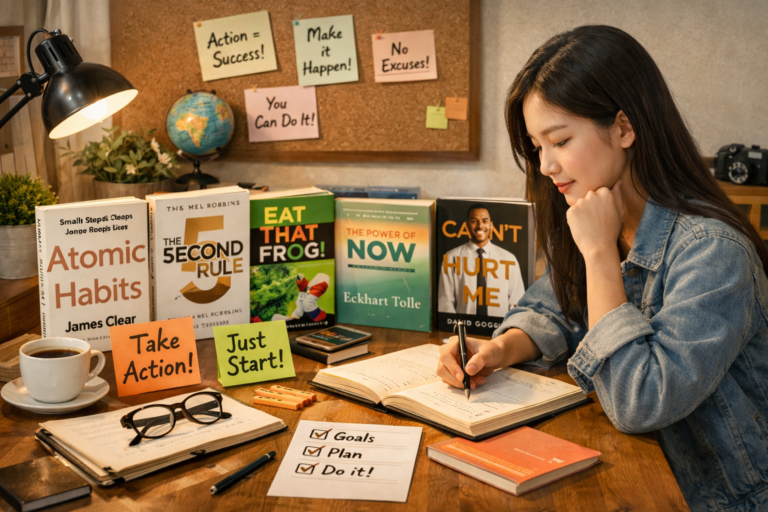

Top Books for Achieving Big Goals

Top Books for Achieving Big Goals
I used to think big goals required big moments.
A sudden burst of motivation. A perfect plan. A clear path from where I was to where I wanted to be.
Something dramatic.
Something that would make everything feel possible all at once.
But that moment never came.
Instead, what I experienced was something much quieter.
Confusion.
Uncertainty.
And a question I kept asking myself:
Where do I even begin?
The Weight of Big Goals
There’s something intimidating about big goals.
They sit in your mind like something distant.
Important—but unclear.
You know they matter.
But the path toward them feels overwhelming.
Too many steps. Too many unknowns.
And because of that, it’s easy to delay.
Not because you don’t care—but because you don’t know how to start.
The First Shift: Break It Down
One of the first lessons I learned from reading was simple:
Big goals are not achieved all at once.
They are built from smaller steps.
At first, that idea felt obvious.
But applying it was different.
Instead of focusing on the final outcome, I started asking:
What is the next step?
Not the whole plan.
Just the next step.
And that made the process feel manageable.
Clarity Over Ambition
Before, I thought ambition was enough.
If I wanted something badly enough, I would find a way.
But books showed me something else.
Clarity matters more.
What exactly are you trying to achieve?
Why does it matter?
What does progress look like?
Without clarity, ambition can become scattered.
And scattered effort leads to slow progress.
Consistency Over Intensity
I used to rely on bursts of effort.
Working hard for a few days—then losing momentum.
But big goals don’t respond well to inconsistency.
Books emphasized a different approach:
Consistency.
Doing something every day.
Even if it’s small.
Because consistency builds momentum.
And momentum keeps you moving.
The Role of Systems
One idea that appeared again and again:
Don’t just focus on goals.
Focus on systems.
Goals define what you want.
Systems define what you do daily.
And it’s the daily actions that lead to results.
This shifted my focus.
From thinking about outcomes—to thinking about habits.
When Motivation Fades
Motivation is unreliable.
There are days when it’s strong.
And days when it’s not.
Before, I depended on it.
Now, I expect it to fluctuate.
Books helped me understand that progress doesn’t depend on motivation.
It depends on commitment.
Showing up—even when you don’t feel like it.
The Gap Between Knowing and Doing
One of the most frustrating things I experienced was this:
I knew what to do.
But I didn’t always do it.
Books helped me understand that this gap is normal.
Knowing is not enough.
You have to act.
Even when it’s uncomfortable.
Even when it’s not perfect.
Learning to Adjust
Big goals rarely go exactly as planned.
There are setbacks.
Unexpected challenges.
Moments where things don’t work.
Books prepared me for that.
Not by removing the difficulty—but by helping me adapt.
To adjust the plan.
To keep moving forward—even when things change.
The Importance of Patience
This was one of the hardest lessons.
Big goals take time.
Longer than you expect.
Before, I wanted quick results.
Fast progress.
But that expectation created frustration.
Books helped me shift my perspective.
To see progress as something gradual.
Something that builds over time.
Measuring Progress Differently
At first, I looked for visible results.
Clear signs that I was moving forward.
But those signs don’t always appear quickly.
Books encouraged me to measure progress differently.
Effort.
Consistency.
Improvement.
Those are also forms of progress.
Staying Focused on What Matters
When you’re working toward a big goal, distractions become more noticeable.
Other opportunities. Other ideas.
It’s easy to shift direction.
Books helped me stay focused.
To remember why I started.
And to prioritize what matters most.
The Role of Reflection
Reflection became an important part of the process.
Looking back.
What worked? What didn’t?
What can I improve?
Books encouraged this habit.
Because reflection turns experience into learning.
When Doubt Appears
There were moments when I doubted everything.
The goal. The process. Myself.
And that’s part of it.
Books didn’t remove doubt.
But they helped me understand it.
To see it as something temporary—not permanent.
Building Resilience
Big goals require resilience.
The ability to continue when things are difficult.
When progress feels slow.
When results are not visible.
Books reinforced this idea.
Not through motivation—but through perspective.
A Personal Reflection
Looking back, I didn’t achieve anything big overnight.
It happened gradually.
Through small steps.
Through consistent effort.
Through learning and adjusting along the way.
And reading played a role in that.
Not by giving me a perfect plan—
but by helping me understand the process.
Final Thoughts
If you want to achieve big goals, books can guide you—but they won’t do the work for you.
They will help you think more clearly.
Plan more effectively.
Stay consistent.
But progress comes from action.
From showing up.
From continuing—even when it’s difficult.
So start small.
Take one step.
Then another.
And trust the process.
Because big goals are not achieved in big moments.
They are built in small actions—
repeated over time.
And those actions—
quiet, consistent, and intentional—
are what make the difference.