
What Is the Charlotte Mason Method ?
When parents first start researching homeschooling, they quickly realize one thing:
there are too many methods, too many opinions, and too much noise.
Among all those approaches, the Charlotte Mason method keeps coming up again and again—especially for families who want something gentle, meaningful, and literature-rich.
So what exactly is the Charlotte Mason method?
Is it outdated?
And why do so many homeschool families still choose it today?
Let’s break it down in a simple, practical way.

Who Was Charlotte Mason?
Charlotte Mason was a British educator who lived in the late 19th and early 20th centuries. She worked closely with children and teachers and spent her life studying how children naturally learn best.
Instead of creating rigid lesson plans or memorization-heavy systems, she focused on something radical for her time:
“Education is an atmosphere, a discipline, and a life.”
Her ideas eventually became the foundation of what we now call the Charlotte Mason homeschooling method.
The Core Philosophy of the Charlotte Mason Method
At its heart, the Charlotte Mason method is based on one powerful belief:
Children are whole persons, not empty containers waiting to be filled with information.
This means education should:
- Respect the child’s mind
- Feed curiosity
- Encourage independent thinking
- Cultivate good habits and character
Instead of overwhelming children with worksheets and busywork, Charlotte Mason believed in quality over quantity.
The 6 Core Principles of the Charlotte Mason Method
While Charlotte Mason wrote extensively, most homeschool families follow these six foundational ideas.
1. Children Are Born Persons
Children are not “unfinished adults.”
They deserve respect, responsibility, and meaningful ideas from the start.
In practical terms:
- Children engage with real books, not watered-down summaries
- They are trusted to think, reflect, and form opinions
- Learning is not forced through endless repetition
2. Education Is a Life
Charlotte Mason believed education should nourish the mind the same way good food nourishes the body.
This is why living books are central to the method.
Living books are:
- Written by passionate authors
- Rich in language and ideas
- Engaging and narrative-driven
Instead of textbooks packed with facts, children learn through stories, biographies, and well-written nonfiction.
3. Short Lessons Encourage Focus
Rather than long, exhausting school days, Charlotte Mason recommended short, focused lessons.
Typical lesson lengths:
- Young children: 10–20 minutes
- Older children: 20–45 minutes
Short lessons:
- Improve attention
- Reduce burnout
- Encourage mental discipline
Children learn to give their full focus—then move on.
4. Narration Replaces Worksheets
One of the most distinctive features of the Charlotte Mason method is narration.
Instead of answering comprehension questions or filling in blanks, children:
- Listen to or read a lesson
- Retell it in their own words
Narration can be:
- Oral (for younger children)
- Written (for older students)
- Illustrated (drawing or sketching)
This practice:
- Strengthens comprehension
- Develops memory
- Improves communication skills
5. Habit Training Matters
Charlotte Mason believed good habits shape a child’s future more than raw intelligence.
Some habits emphasized include:
- Attention
- Truthfulness
- Order
- Kindness
- Self-discipline
Habits are taught gently, consistently, and intentionally—one at a time.
6. Nature Study and Real-World Learning
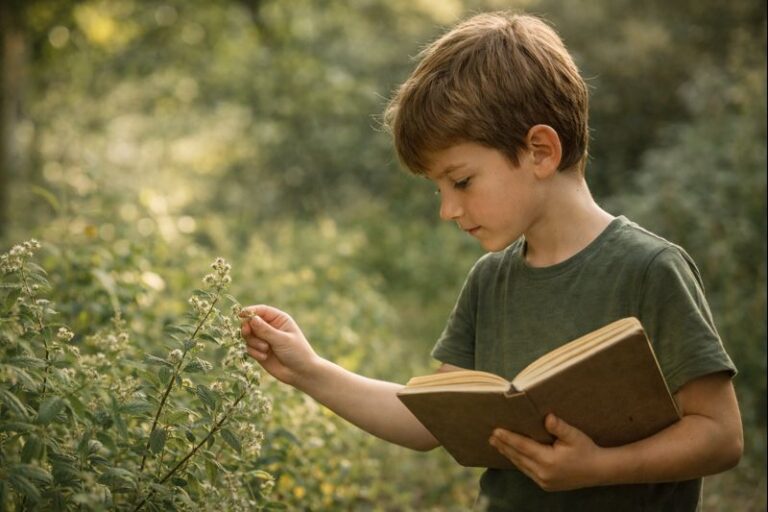
Children are encouraged to spend time outdoors observing the real world.
Nature study includes:
- Keeping a nature journal
- Identifying plants and animals
- Observing seasonal changes
This builds:
- Observation skills
- Curiosity
- Appreciation for the natural world
What Subjects Look Like in a Charlotte Mason Homeschool
The Charlotte Mason method covers all core subjects, but the approach looks different from traditional schooling.
Language Arts
- Reading high-quality literature
- Copywork (copying well-written passages)
- Dictation
- Narration
History
- Learned through historical narratives and biographies
- Studied chronologically
- Often combined with geography and timelines
Science
- Nature study in early years
- Later years introduce living science books
- Focus on observation and curiosity, not memorization
Geography
- Map work
- Living geography books
- Travel narratives and cultural studies
Art and Music
- Artist study
- Composer study
- Exposure to fine art and classical music
What the Charlotte Mason Method Is NOT
Many misunderstandings come from confusing Charlotte Mason with other approaches.
It is not:
- Unstructured or chaotic
- Anti-discipline
- Academically weak
- Only for young children
In fact, older students often thrive with Charlotte Mason because it encourages deep thinking, writing skills, and independent learning.
Who Is the Charlotte Mason Method Best For?
This approach tends to work especially well for families who:
- Prefer literature over textbooks
- Want a calm, meaningful homeschool rhythm
- Value character and habits alongside academics
- Want to avoid burnout and pressure
- Have children who love stories and discussion
It can be adapted for:
- Single-child families
- Large families
- Multiple ages learning together
Common Concerns Parents Have
“Is it rigorous enough?”
Yes—when done consistently, narration, reading, and writing build strong academic skills.
“Is it too gentle?”
Gentle does not mean easy.
It means respectful, focused, and intentional.
“Can it work for high school?”
Absolutely. Many families successfully use Charlotte Mason through high school with deeper reading, writing, and analysis.
Why the Charlotte Mason Method Is Still Popular Today
In a world of:
- Screen overload
- Test pressure
- Shallow content
The Charlotte Mason method offers something different:
- Depth over speed
- Wisdom over information
- Thoughtfulness over busyness
It helps children learn how to think, not just what to memorize.
Final Thoughts
The Charlotte Mason method is not a trend.
It’s a philosophy that has lasted over a century because it respects children as learners and people.
Once parents understand how children learn best, the next natural step is choosing resources and curricula that align with this philosophy.
Understanding the method first makes every future homeschool decision clearer.

Homeschool researcher and literature-based education advocate at Story Schooling. She focuses on Charlotte Mason philosophy and thoughtful homeschooling approaches to help families choose meaningful learning paths for their children.